The Exploding Whale Disaster: When a Simple Plan Turned Into Chaos
How a decision to dispose of a dead whale with dynamite in 1970 Oregon created one of the strangest and most widely remembered disasters ever filmed
In November 1970, officials in a small coastal town in Oregon were faced with a problem that was both unusual and increasingly urgent. An enormous 45-foot sperm whale had washed up on the beach near Florence. It was dead, and already beginning to decompose.
At first, it was a colossal, if morbid, curiosity. Beachgoers and locals came to have a look and take photos. But as the hours passed, the situation, predictably, became less interesting and more unpleasant. The whale’s body began to swell with gases produced by decomposition, and a foul smell spread across the area. It was clear that something had to be done. And fast.
Moving the whale wasn’t a realistic option. It weighed around eight tons, far too heavy for the equipment readily available. But leaving it where it was would only make matters worse. As it continued to rot, the carcass would attract scavengers and create a serious public nuisance. The stench was only going to get more pungent. The longer it remained, the more difficult the cleanup would become.
Responsibility fell to the Oregon State Highway Division, which oversaw the area. After considering the options, officials settled on a solution that seemed, at least on paper, both efficient and effective. Hindsight would disagree.
They would dispose of the whale using explosives.
It wasn’t as crazy as it sounds
The idea was not entirely without logic. The theory was that by blowing the carcass apart, the remains would be reduced to smaller pieces that could be more easily cleared away. It was also assumed that much of the whale would be consumed by scavenging birds, particularly seagulls, which were common along the coast. What remained could then be buried or removed.
To carry out the plan, the division arranged for a demolition expert to place charges beneath the whale. Around half a ton of dynamite was used. This is a lot of dynamite - an amount typically used to shift huge rocks in quarries. While this may seem excessive, keep in mind that the idea was to obliterate the carcass.
Crowds gathered, and the whale was blown up… spectacularly
Word of the planned explosion spread quickly. On the day of the operation, a crowd had predictably gathered at what was assumed to be a safe distance. No one wanted to miss seeing a whale being turned into chunks by a huge amount of dynamite. Among them was a reporter from local station KATU, who had come to document the unusual event.
Shortly after the charges were set, the area was cleared, and the detonation was triggered.
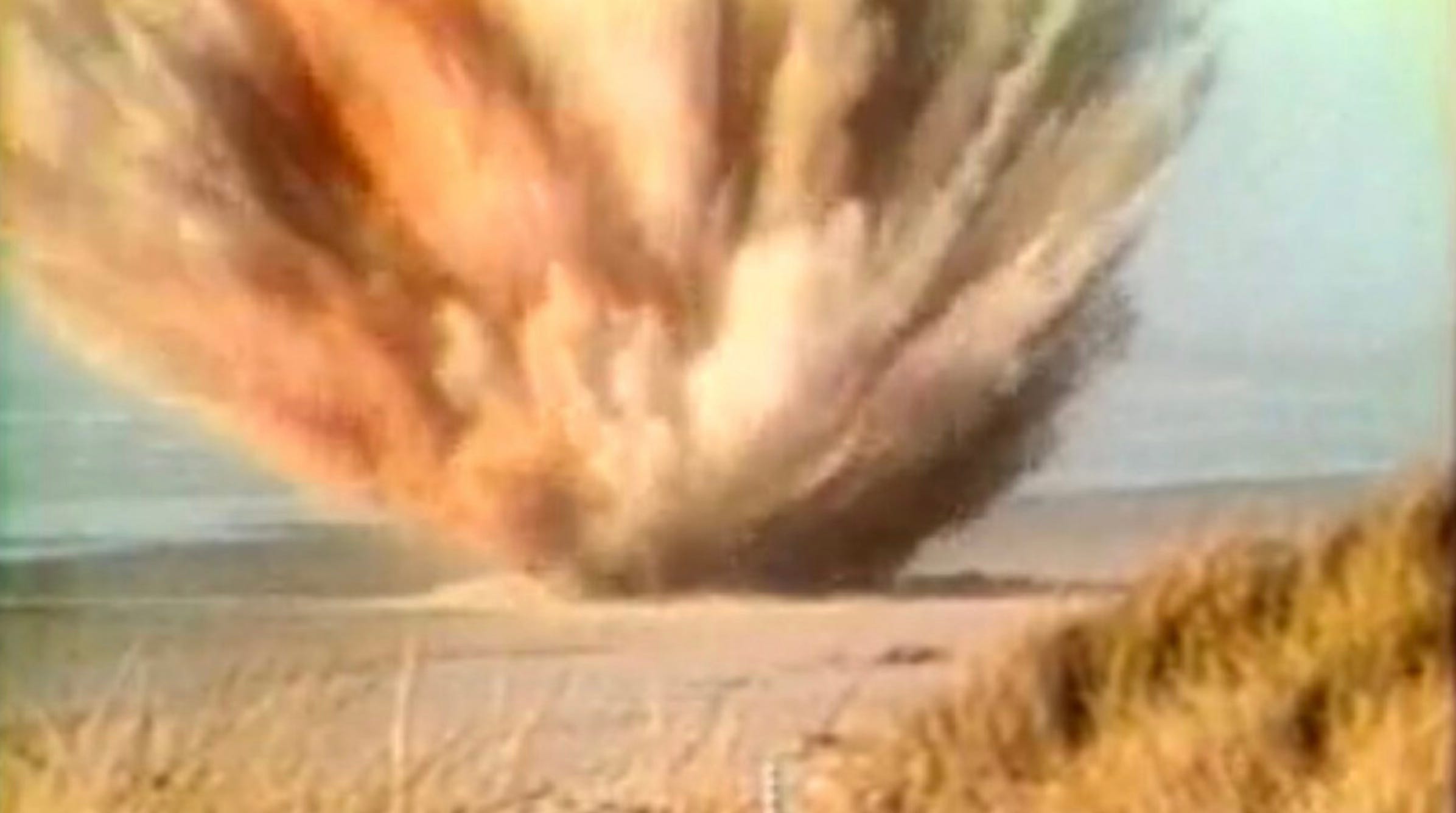
For a brief moment, the plan appeared to work. The explosion sent a plume of slightly pinkish sand and debris into the air. The whale’s body seemed to disintegrate under the force of the blast. Then, as the dust began to settle, it became clear that something had gone badly wrong.
Chunks of whale rained down
Instead of being reduced to small, easily manageable pieces, large sections of whale flesh had been launched high into the air. And these chunks did not fall harmlessly onto the beach. They came down over a wide area, landing on spectators, covering the surrounding ground, and striking nearby vehicles with considerable force.
One large piece crushed the roof of a parked car. Smaller fragments rained down across the site, coating everything in a layer of oily, foul-smelling blubber. The crowd, which had gathered to watch a controlled demolition, found itself similarly covered by putrid matter as they scrambled to avoid falling debris.
The situation was now considerably worse
The assumption that scavenging birds would quickly deal with the remains also proved optimistic. The seagulls, far from clearing the site, were initially driven away by the blast. What was left behind was not a solved problem but a far larger and more complicated one.
Cleanup efforts became vastly more difficult. Instead of a single carcass to manage, officials now had to deal with whale remains scattered across a wide area. The explosion had literally spread the problem.
The whole thing was recorded, and lessons were learned
The incident might have been remembered as a local misjudgment and little more, but for the footage captured that day. The KATU report showed the explosion, the immediate aftermath, and the stunned reactions of those present. Delivered in a calm, matter-of-fact tone, the narration contrasted sharply with the chaos unfolding on screen.
Over time, the clip gained a reputation far beyond Oregon. It was replayed on television, shared in documentaries, and went the pre-internet version of viral. It has since circulated widely online and even been parodied on The Simpsons. The “exploding whale” became a kind of modern folklore - an example of something that seemed good on paper, but failed spectacularly.
In the years that followed, approaches to dealing with large beached animals became, understandably, more cautious and restrained. Burial, removal, or controlled decomposition are generally preferred.
The lesson had been learned - even if it had been learned in an unusual way.
I don’t normally post clips, but here is the news report. Obviously, this footage includes an exploding whale, so don’t watch if that might disturb you.
If you enjoyed this, you might also like:
History’s Most Disgusting Mystery: The Great Kentucky Meat Rain Of 1876
On the 3rd of March, 1876, Mary Crouch of Olympia Springs, Kentucky, was outside making soap. It was almost midday, and the skies were clear.
A City Dancing Till Death, Meowing Nuns, And Other Weird Cases Of Mass Hysteria
A couple of weeks ago, I wrote about the mass hysteria that led to the Great Singaporean Penis Panic of 1967. While researching that article, I came across numerous stories of mass hysteria throughout history. Some of them were fascinating, and if they weren’t so documented, they would be hard to believe.
Exploding Bats and Spy Cats: 5 Times War Got Seriously Weird
The bat bomb experiment worked a little too well


I remember watching this on a caught-on-camera type show, which were popular in the mid 90s-early 2000s. Stacy Keach narrated. The best line in the whole thing came after showing the obliterated car, which was something to the effect of 'nothing's worse than someone blowing chunks on your car.' I still have it on VHS somewhere.